
How to Choose a Replacement PTAC: 6 Things to Check Before You Order
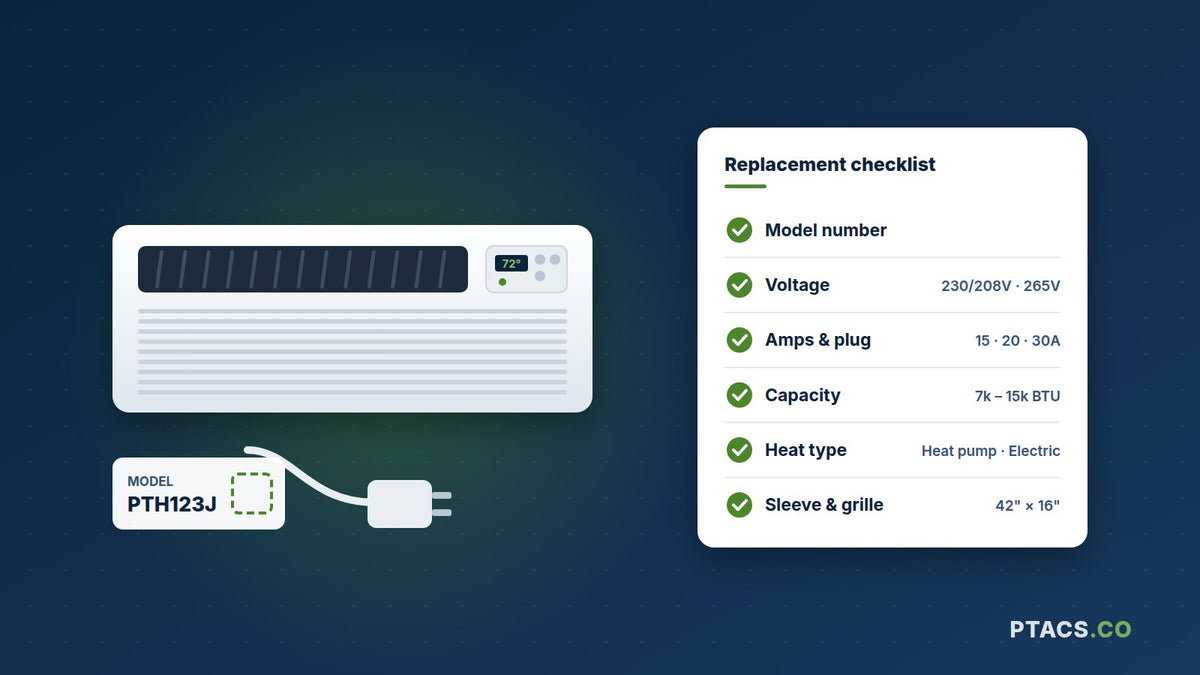
When a PTAC fails in a guest room or apartment, the pressure is on to get a replacement in fast. But a unit that doesn't match the wall sleeve, the receptacle or the building's voltage can't be installed, and it can mean another week of an unusable room. The good news: getting it right comes down to six checks.
1. Find the model number on the rating plate
Everything starts here. Remove the front cover of the existing unit; the rating plate is a label on the chassis, usually on the left side or front. It lists the model and serial number, voltage, amperage, cooling capacity and heater size.
2. Match the voltage
PTACs are built for either 230/208V or 265V. The two are not interchangeable. Most apartments and smaller hotels use 230/208V, while many larger commercial buildings with 277V service use 265V units. Your new PTAC must match the power supplied at the wall.
3. Match the amperage and plug
The cord on the new unit has to fit the existing receptacle, and the circuit breaker has to support the unit's heater size. Plug shapes differ by voltage and amperage:
| Voltage | Amperage | Plug (NEMA) |
|---|---|---|
| 230/208V | 15 amp | 6-15P |
| 230/208V | 20 amp | 6-20P |
| 230/208V | 30 amp | 6-30P |
| 265V | 15 amp | 7-15P |
| 265V | 20 amp | 7-20P |
| 265V | 30 amp | 7-30P |
Never modify a plug or force it into a receptacle. If the new plug doesn't match, have an electrician confirm the circuit before installation.
4. Choose the right capacity (BTU)
If the old unit kept the room comfortable, replace it like-for-like. Bigger isn't better: an oversized PTAC cools the room too quickly, shuts off before removing humidity and leaves the air feeling damp. As a general guide:
| Room size | Typical PTAC size |
|---|---|
| Up to 300 sq ft | 7,000 BTU |
| 300 – 400 sq ft | 9,000 BTU |
| 400 – 550 sq ft | 12,000 BTU |
| 550 – 700 sq ft | 15,000 BTU |
5. Decide between heat pump and electric heat
Both types cool the same way. The difference is heating:
- Heat pump PTACs reverse the refrigeration cycle to move heat indoors, which uses far less energy in mild weather. They switch to a backup electric heater when it gets colder outside.
- Electric heat PTACs ("cooling with electric heat") use a resistance heater. They cost less upfront but more to run during the heating season.
In most climates, a heat pump pays back its higher price through lower heating bills. Browse PTAC heat pumps or all PTAC units.
6. Check the wall sleeve, grille and drain
Most current PTACs from Amana, Friedrich, GE and Hotpoint fit the industry-standard 42" × 16" wall sleeve, so a new chassis can often slide into the existing sleeve. Before ordering, confirm:
- Sleeve depth and condition: rusted, damaged or poorly sloped sleeves can leak and should be replaced.
- Outdoor grille type: stamped aluminum, architectural or polymer.
- Drain setup: whether you need a drain kit or a model with internal condensate removal.
Need a new sleeve, grille or drain kit? See Parts & Accessories.
Quick checklist
- Photo of the rating plate
- Voltage: 230/208V or 265V
- Amperage and plug type
- BTU capacity
- Heat pump or electric heat
- Sleeve, grille and drain condition
Not sure which unit you need?
Send us a photo of your rating plate, your quantity and delivery ZIP code. We'll confirm the right replacement and send a quote, usually within one business day.
Request a Quote →Call (800) 574-4561

